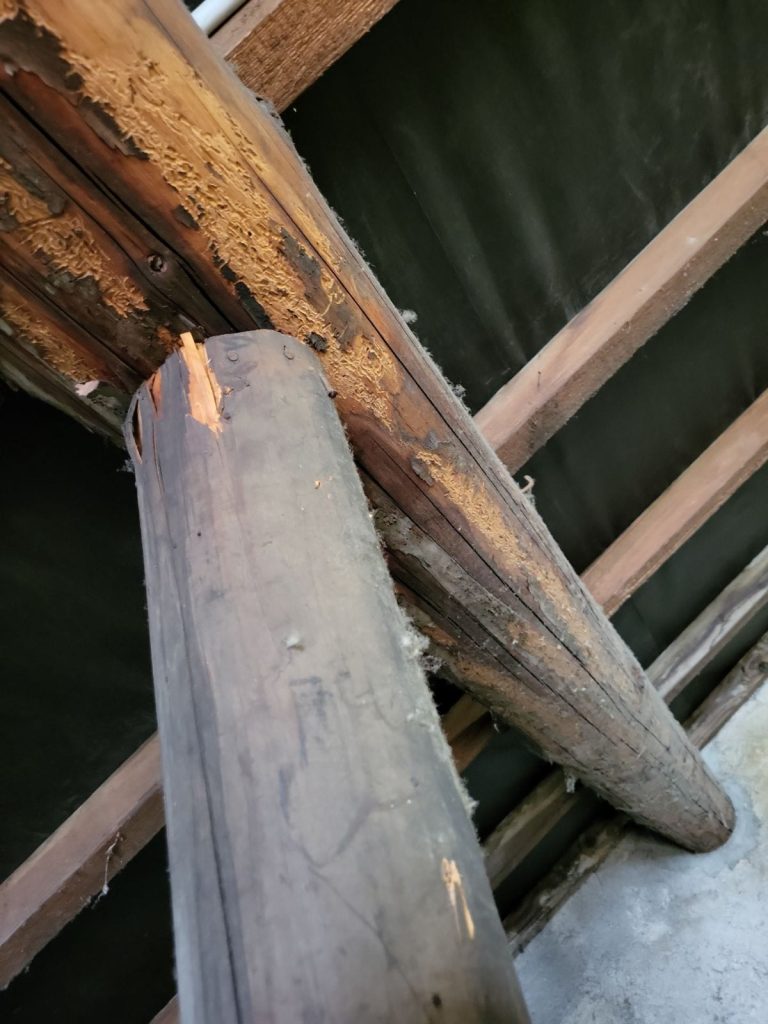
Roof-timber treatment against wood-boring insect larvaeLocation: Luxembourg
Project description
After receiving an urgent call from our clients in Luxembourg, our team treated roof timbers infested with wood-boring insect larvae that were beginning to cause significant damage.
The spread of these insects poses a serious threat to the structure of the house because they feed on the wood, creating tunnels that weaken essential parts of the roof structure. By treating the infestation promptly, we were able to stop these pests from spreading and preserve the structure's strength.
Initial assessment and project background
Although wood-boring insect larvae are invisible at the start of an infestation, they leave characteristic signs: holes from which adult insects emerge and a growing network of tunnels that weakens the wood. Their prolonged presence in the roof timbers threatens the building's integrity because the tunnels they bore compromise the strength of the beams. These insects can also migrate easily from one house to another, making prompt intervention essential to protect not only the infested house but neighbouring properties as well.
To address this problem, our team used a two-stage approach. First, we injected an insecticidal and fungicidal treatment deep into the affected timber to treat the wood thoroughly. We then sprayed the surface of every timber element in the roof structure to eliminate any remaining larvae and provide long-lasting protection against further infestations.
Project objectives
Eliminate wood-boring insects and their larvae
Deep injection and surface application of an insecticidal treatment eliminate adult insects and larvae still present in the wood, stopping the infestation from spreading.
Protect the roof timbers against future infestations
By impregnating the wood with a fungicidal and insecticidal treatment, we created a and and durable protective barrier that prevents the insects from returning and preserves the structure's strength.
Preserve the structure's safety and strength
The tunnels created by wood-boring larvae weaken beams and other roof-timber elements. This treatment protects the remaining sound timber from further damage, helping to preserve the building's safety and structural integrity.